The History of Astrology
From Divine Signs to Inner Meaning
Introduction
Astrology is not a single belief system—it is a 5,000-year conversation between heaven and humanity.
From the priests of Babylon watching the skies for omens, to the philosophers of Alexandria seeking cosmic harmony, to modern astrologers exploring the psyche, astrology has always asked one question:
How does the movement of the heavens mirror the movement of the soul?
The Story of Astrology: A 5,000-Year Comeback Tour
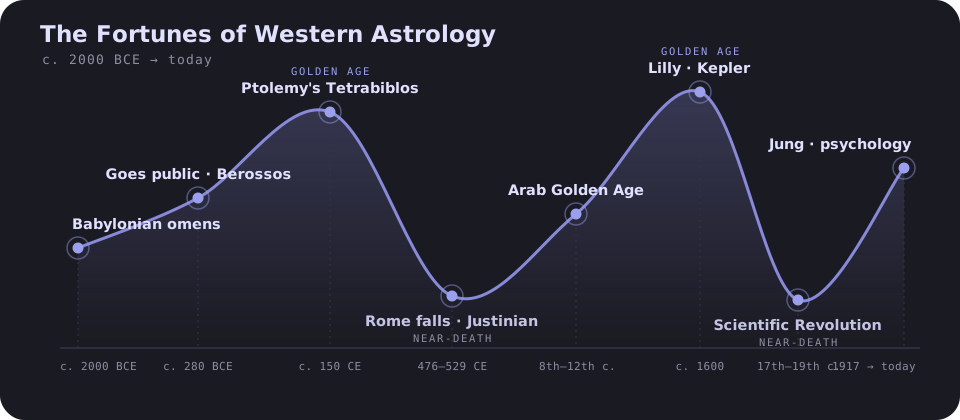
Part 1: The Original Sky-Nerds (c. 2000 BCE)
Part 2: The Greek Makeover (c. 300 BCE)
Part 3: The First Death & the Arab Rescue (c. 500–1200 CE)
Part 4: The Golden Age of the Star-Sellers (c. 1500–1650)
Part 5: The Great Break-Up (17th–19th c.)
Part 6: The Courtroom Drama That Changed Everything (1917)
Conclusion
The history of astrology is not just the story of stars—it is the story of human imagination.
From temples to telescopes, from clay tablets to computer charts, astrology has evolved with our sense of meaning. Once a divine code, now a psychological mirror, it continues to ask:
How do we find order and purpose in the sky above and the soul within? Astrology endures because it changes with us—
a bridge between reason and wonder, structure and mystery, time and eternity.
Key Figures in the History of Astrology
| Era / Cultural Context | Figure | Period | Major Contributions |
| Ancient Mesopotamia (c. 2000–500 BCE) | Babylonian priest-astronomers | — | Recorded planetary motions and celestial omens (Enuma Anu Enlil); developed omen astrology linking divine will to worldly events—the first concept of “as above, so below.” |
| Egyptian & Persian Traditions | — | — | Egypt contributed solar mysticism and the decan system; Persia introduced cyclical time and destiny concepts, both shaping later Hellenistic astrology. |
| Hellenistic Period (3rd cent. BCE – 2nd cent. CE) | Berossos | c. 280 BCE | Chaldean priest who opened the first astrology school in the Greek world (Kos), carrying Babylonian star-lore into Hellenistic culture and the wider public. |
| Vettius Valens | c. 120–175 CE | Author of Anthology; emphasized fate, planetary joys, and experiential astrology. | |
| Dorotheus of Sidon | 1st cent. CE | Codified predictive techniques in verse; foundational for medieval Arabic astrology. | |
| Claudius Ptolemy | c. 100–170 CE | Tetrabiblos systematized astrology scientifically; explained planetary influence via natural causes; established core dignity scheme. | |
| Firmicus Maternus | c. 300–360 CE | Synthesized Greek and Roman traditions; stressed the spiritual and fatalistic dimensions of astrology. | |
| Arabic Golden Age (8th–13th cent.) | Al-Kindi (Ya‘qub ibn Ishaq al-Kindi) | c. 801–873 CE | Integrated Aristotelian philosophy with astrology; discussed the natural mechanism of celestial influence. |
| Mashallah ibn Athari | c. 740–815 CE | Pioneer of horary astrology; cast the founding chart of Baghdad. | |
| Abu Ma‘shar (Albumasar) | c. 787–886 CE | Highly influential theorist of planetary cycles and world eras; his works shaped medieval Europe. | |
| Al-Biruni | c. 973–1050 CE | Scholar of astronomy and geography; emphasized empirical observation and mathematical precision. | |
| Medieval Europe (12th–15th cent.) | Thomas Aquinas | 1225–1274 CE | Theologian who reconciled astrology with free will: “The stars incline, they do not compel.” |
| Renaissance & Early Modern (15th–17th cent.) | Marsilio Ficino | 1433–1499 CE | Neoplatonist philosopher; united astrology with Hermetic and medical thought; viewed the astrologer as a “priest of the cosmos.” |
| Tycho Brahe | 1546–1601 CE | Combined precise astronomical observation with astrological interpretation. | |
| Johannes Kepler | 1571–1630 CE | Reformed aspect theory; explained planetary harmony through geometry and musical proportion. | |
| Galileo Galilei | 1564–1642 CE | Practiced astrology early in his career; symbolized the later split between astronomy and astrology. | |
| William Lilly | 1602–1681 CE | England’s most famous astrologer; his Christian Astrology (1647) became the classic of the horary tradition and his almanac forecasts (including the Great Fire of London) made astrology a thriving profession. | |
| Modern Revival (19th–20th cent.) | Alan Leo | 1860–1917 CE | Father of modern astrology; emphasized character analysis and spiritual development; key Theosophical influence. |
| Carl Gustav Jung | 1875–1961 CE | Introduced synchronicity and archetypes; reframed astrology as symbolic psychology. | |
| Dane Rudhyar | 1895–1985 CE | Founded humanistic astrology; saw the chart as a mandala of self-realization (The Astrology of Personality). | |
| Liz Greene | 1946– | Jungian astrologer; explored planetary “shadow” dynamics (Saturn: A New Look at an Old Devil). | |
| Howard Sasportas | 1948–1992 | Co-founded the Centre for Psychological Astrology with Greene; emphasized houses and growth. | |
| Contemporary Integration (20th–21st cent.) | Jeffrey Wolf Green | 1946–2016 | Originator of Evolutionary Astrology; interpreted charts as maps of the soul’s evolution. |
| Richard Tarnas | 1950– | Philosopher and author of Cosmos and Psyche; developed archetypal astrology linking planetary cycles with cultural history. |
Further Reading
Want to go deeper into the story above? These are the books behind it. (Links go to Amazon.) The classical sources
- Tetrabiblos — Claudius Ptolemy. The treatise that became Western astrology’s standard textbook for a thousand years.
- Christian Astrology — William Lilly. The 17th-century classic of the horary tradition.
- Hellenistic Astrology: The Study of Fate and Fortune — Chris Brennan. A modern reconstruction of the original system.
The psychological turn
- Cosmos and Psyche — Richard Tarnas. Archetypal astrology and the cycles of cultural history.
- Saturn: A New Look at an Old Devil — Liz Greene. The book that launched psychological astrology.
- The Astrology of Personality — Dane Rudhyar. The founding text of humanistic astrology.
Free Tool
Calculate your birth chart
Turn these archetypes into your own sky — planets, houses, and aspects, free.
Open the CalculatorRelated in Astrologer